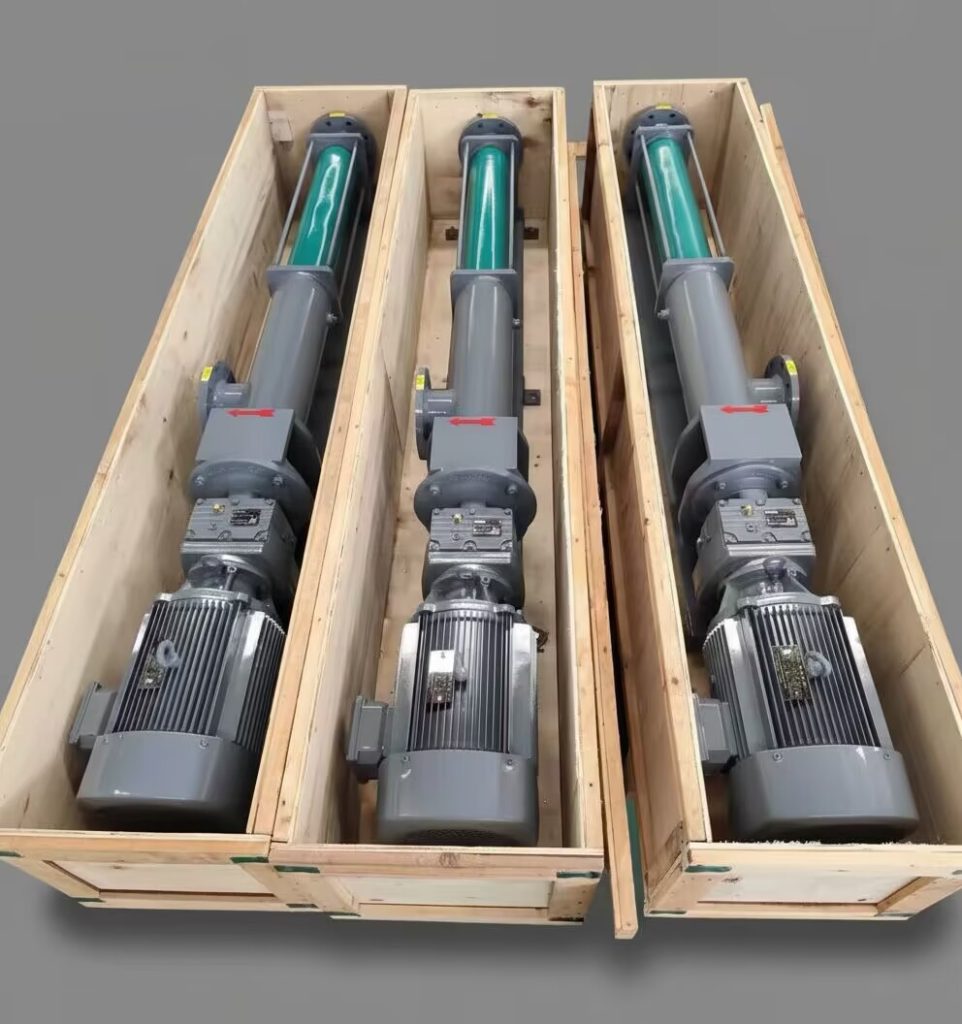
1. Terminology Translation
screw pump for sewage sludge = sewage sludge screw pump
It is specially designed for sewage sludge transportation, generally referring to Progressive Cavity Pump (PCP) in the industry.
2. Core Definition
The sewage sludge screw pump is a positive displacement volumetric pump. It relies on the eccentric rotation of the metal rotor inside the rubber stator to form continuous sealed cavities, which steadily convey high-viscosity and solid-laden sewage sludge. It is widely applied in municipal and industrial wastewater treatment processes.
3. Working Principle (Progressive Cavity Pump)
Core components:
Rotor: single-start metal screw with chrome plating or tungsten carbide hardening treatment.
Stator: double-start helical rubber liner made of wear-resistant NBR / EPDM material.
Conveying process:
The motor drives the rotor into eccentric rotation → dynamic sealed cavities are formed → sludge is sucked in and delivered axially in a continuous, pulse-free flow → medium is conveyed from inlet to outlet.
Key features:
Low shear force (protects sludge flocs and benefits subsequent dewatering); strong self-priming capacity (suction lift: 4–8 m, allowing short-time dry running); suitable for high solid content (solid content up to 10%–40%).
4. Main Types for Sewage Sludge Application
- Progressive Cavity Pump (PCP, most widely used)Suitable for thickened / dewatered sludge with solid content of 5%–30%. Features stable flow, clog resistance and wear resistance; used for sludge transportation, chemical dosing and dewatering machine feeding.
- Twin Screw PumpApplicable for high pressure (≤30 bar) and large flow scenarios, such as long-distance pipeline transportation and high-pressure sludge injection. No metal contact and low wear.
- Archimedean Screw Pump (open type)Suitable for raw sewage, rainwater and low-concentration sludge. Large flow passage and non-clog design; ideal for lifting after coarse screening.
5. Typical Application Scenarios
- Municipal Wastewater Treatment Plant: Conveying primary sludge, excess sludge and digested sludge to thickener and dewatering machine.
- Industrial Wastewater: Conveying high-viscosity sludge and fiber / particle contained wastewater in chemical, papermaking, printing & dyeing and food industries.
- Sludge Disposal: Feeding for plate-and-frame filter press and belt filter press; sludge reflux and chemical dosing (e.g. PAM).
6. Key Parameters for Selection
- Flow rate: 0.1–600 m³/h (variable frequency adjustable)
- Pressure: 0.6–2.4 MPa (single stage); up to 4.8 MPa for multi-stage
- Medium viscosity: ≤1,000,000 mPa·s
- Temperature range: -10℃–150℃ (depending on material)
- Material options:Pump casing: Cast iron / SUS304 / SUS316L / Duplex steelRotor: 40Cr / SUS316 with hard coatingStator: NBR / EPDM / Viton
7. Advantages & Disadvantages
Advantages
✅ Capable of conveying high-viscosity, high-solid-content sludge containing fiber and particles without clogging.
✅ Continuous pulse-free flow, ideal for quantitative conveying and chemical dosing.
✅ Low shear performance protects sludge flocs and improves dewatering efficiency.
✅ Excellent self-priming performance, flexible installation and allow dry start.
Disadvantages
❌ The stator is a wearing part with service life of 6–12 months, requiring regular replacement.
❌ Low-speed operation is required for high-viscosity sludge; otherwise, overload and accelerated wear will occur.
kynspump Intl. Generic spares for Netzsch Pump Parts, Seepex Spare Parts, Mono Pump Rotor, Stator Replacement parts, PCM… 100% compatible, equivalent lifespan as the original parts
Contact us for immediate inquiry:E-mail:celia@kynspump.com,WhatsApp:+86 153 1226 1613